
Find The Cat 2 - Spot It!
Agave GamesPuzzle
4.92.55K Reviews
- Version
- 1.20.0
- Installs
- 5.00M
- Age Rating
- Everyone
Screenshots
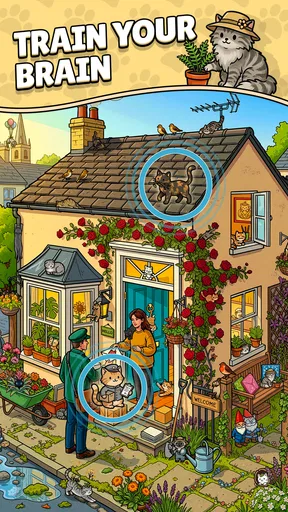
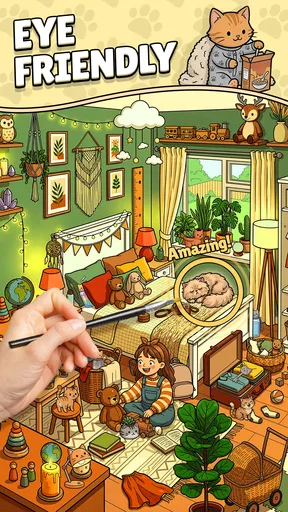

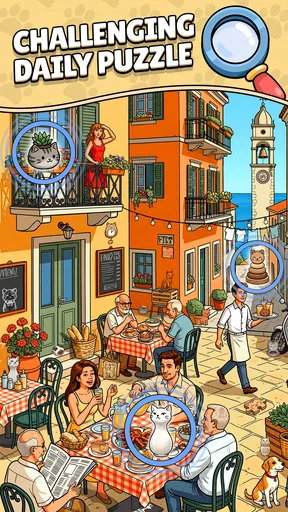
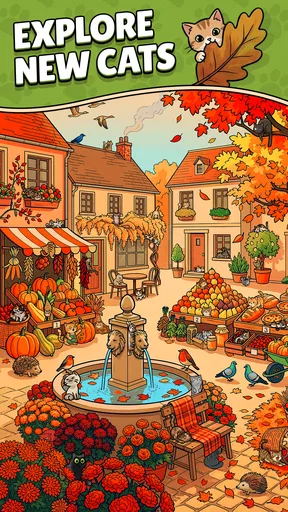

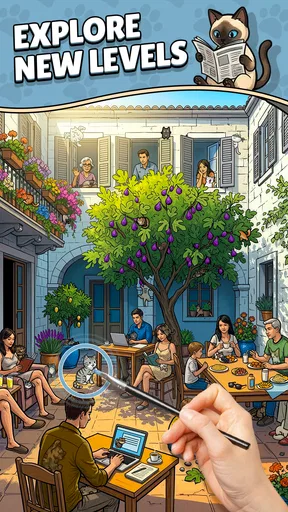
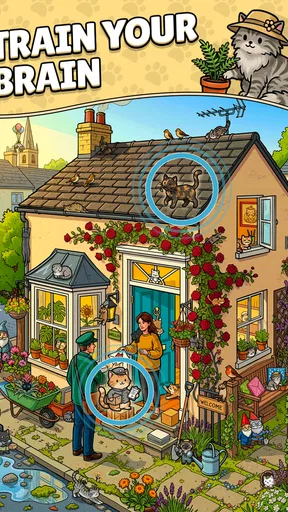
Our Review of Find The Cat 2 - Spot It!
 Analysis by Appyee
I spent time with Find The Cat 2 - Spot It! as a casual puzzle game, and its appeal is easy to understand: each session turns the simple idea of looking for cats into a small visual search challenge. It is made by Agave Games, belongs to the puzzle category, and is free to start. That combination makes it approachable, especially when I want something lighter than a competitive game or a long story-driven adventure.
The important question is not whether the concept is complicated—it is not—but whether searching carefully remains enjoyable after the first few rounds. In my experience, the answer depends on what you expect from a mobile game. If you like quiet observation, gradual improvement, and short bursts of concentration, this is a pleasant fit. If you need deep strategy, a strong narrative, or constant mechanical variety, the basic search format may feel too narrow.
How the cat-finding puzzle works in everyday play
The central task is straightforward: examine the scene and find the cats hidden within it. That simplicity is the game’s greatest strength because I can understand what to do immediately, without reading a long tutorial or learning a complicated control scheme. The challenge comes from attention rather than speed or technical skill, so the game feels welcoming even when I only have a few minutes available.
I found the best way to play is to treat each picture like a visual sweep instead of tapping randomly. I usually divide the scene into sections, check the edges first, then move across the center in a steady pattern. This sounds obvious, but it makes a real difference when a cat blends into nearby shapes or sits in a place my eyes initially dismiss as decoration. The game rewards patience more than frantic tapping.
That makes it useful for ordinary moments when I want a mental break without committing to a full gaming session. I can imagine opening it while waiting for an appointment, during a short commute as a passenger, or after dinner when I want something calmer than an action game. It also works well for sharing the screen with another person: one player can scan the left side while the other checks the right, turning a solo puzzle into a small cooperative activity even without changing the basic objective.
The store summary describes the goal as finding all the cats, and that focus is reflected in the experience. There is no need to manage an inventory, master a large skill tree, or remember a complicated plot. For me, that clarity is refreshing. I can stop after one challenge and return later without needing to reconstruct where I was or why a particular task mattered.
Why the simple format can still be satisfying
Hidden-object puzzles often look easier than they feel. The first glance gives the impression that the answer should be obvious, but visual scenes can become surprisingly demanding once I have already checked the most prominent areas. The satisfaction comes from changing how I look: instead of searching for an entire cat shape, I start noticing ears, tails, eyes, or an unusual outline among repeated patterns.
One useful habit is to pause after a failed scan rather than immediately repeating the same movement. I zoom my attention out mentally, compare areas with similar colors, and look for objects that seem slightly out of place. This approach is more effective than tapping every attractive detail. It also keeps the game from becoming a test of luck, because careful observation gives me a practical method for improving.
Another small trade-off is that the game’s relaxed premise can make a difficult scene feel more frustrating than expected. When I am in the mood for a calm puzzle, I do not necessarily want to feel stuck searching the same corner repeatedly. The experience is strongest when I accept that some rounds require a slower scan and resist treating every puzzle like a race.
For families, the Everyone content rating makes the game broadly approachable. I would still recommend that parents try a session themselves before handing over a device, not because the premise is intimidating, but because the right fit depends on a child’s patience and comfort with visual searching. A player who enjoys spotting details may be absorbed; someone who prefers immediate action may lose interest quickly.
Free access and what the purchase range means
The game is free to download and play, which lowers the risk of trying it. It also includes in-app purchases priced from $2.99 to $8.99 per item. That is the clearest cost consideration for a prospective player: the initial entry point is free, while optional spending can increase the total cost for people who choose to buy items.
I would approach those purchases as a personal value decision rather than an automatic part of the game. If the free experience already gives me enough enjoyable searching, there is no reason to pay simply because an option is visible. On the other hand, someone who plays frequently and finds a particular purchase genuinely useful may consider the lower end of the range reasonable for a hobby they return to often. The higher end deserves more thought, especially for a game built around a focused, repeatable idea rather than a wide collection of unrelated modes.
This distinction matters when comparing it with traditional paid puzzle games. A one-time purchase can be easier to understand because the cost is settled at the beginning, while a free game with optional items asks me to decide gradually. The free model is better for testing whether I enjoy the visual-search format, but it requires more discipline if I want to keep spending under control. I would start free, play enough to see whether the core activity holds my attention, and only then consider an optional purchase.
For a casual player, the strongest value is the ability to try the main concept without paying first. For a dedicated hidden-object fan, the value depends on how much fresh satisfaction the available puzzles provide over time. I would not judge the game solely by its free label or by the existence of purchases; I would judge whether I am still enjoying the search after the novelty has settled.
What it does better than familiar puzzle alternatives
Compared with match-three games, this is less about building combinations and more about visual patience. There is no pressure to plan several moves ahead in the same way, and the mental reward comes from recognition rather than chain reactions. That makes it a better choice when I want to slow down and observe instead of constantly optimizing a board.
Compared with word puzzles, it asks for a different kind of concentration. I do not need a large vocabulary or knowledge of trivia; I need to notice small visual differences. That makes it accessible to players who find word games tiring, although it will not replace them for anyone who prefers language-based problem solving.
Compared with large hidden-object adventures, the cat-focused format feels more direct. A story-heavy alternative may offer stronger progression, characters, and varied objectives, while this game’s identity is concentrated around spotting cats. I prefer this one when I want to begin playing immediately and leave without losing the thread of a narrative. I would choose the larger adventure instead when I want exploration, plot, or a more substantial long-term journey.
It also differs from competitive puzzle games because the main satisfaction is personal. I am trying to improve my own observation, not defeat another player or maintain a leaderboard position. That is a benefit for anyone who finds competitive pressure tiring, but a drawback for players who need social rivalry to stay engaged.
Small techniques that make difficult scenes less tiring
My most useful technique is to create a repeatable scan route. I start at one corner, move horizontally, drop to the next band, and continue until the whole image has been covered. This prevents the common mistake of staring at the center while ignoring borders, spaces between objects, and areas with low contrast.
I also separate “possible cat” from “confirmed cat.” A shape that resembles an ear or tail can distract me for too long. I mark it mentally, continue searching, and return only if the rest of the scene does not produce an answer. This keeps one ambiguous detail from consuming the whole session.
A third approach is to change the viewing distance. When I hold the phone too close, I focus on tiny details and lose the overall composition. Pulling back slightly helps me notice an outline that blends into the larger scene. Then I move closer again to inspect suspicious areas. This simple rhythm is more comfortable than keeping my eyes fixed at one distance.
These methods are not separate game modes or hidden systems; they are ways to get more from the game’s core design. They also reveal the main trade-off: the better I become at scanning, the more the experience depends on my willingness to concentrate. Someone looking for a game that plays itself in the background will probably find this a poor match.
Who is likely to enjoy it most
I would recommend it first to players who like visual puzzles and want a low-pressure activity. It suits people who enjoy noticing details in illustrations, solving one focused problem at a time, and taking breaks without committing to a long campaign. The free starting point makes it especially sensible for anyone unsure whether hidden-object gameplay is for them.
It is also a good option for households looking for a simple game that can be passed between family members. The objective is easy to explain, and a younger or less experienced player can understand the basic task quickly. Playing together can add conversation and shared discovery, even though the game itself remains centered on individual observation.
I would be more cautious about recommending it to players who need constant novelty. If your favorite puzzle games introduce new rules, complex systems, or increasingly strategic decisions, a focused cat-search game may feel limited. Likewise, players who dislike spending prompts should pay attention to their own habits. Because optional items range in price, the free entry point is most valuable when you are comfortable treating purchases as genuinely optional.
It may also be the wrong choice for anyone seeking a fast reflex challenge. The pleasure here comes from looking carefully, not reacting quickly. Even when I play efficiently, the game rewards a calm eye more than rapid fingers. That makes it relaxing for some people and under-stimulating for others.
Performance expectations and the current release
The current version is 1.13.1, and the listed minimum operating system is Android 10. That requirement is worth checking before installing, particularly if you keep an older phone for casual games. On a compatible device, the game’s focused design makes sense as a pick-up-and-play title rather than something that demands a large time investment each time it opens.
The game has reached over a million installs, with an average rating of 4.9 from around fifty-three thousand ratings and about one thousand six hundred written reviews. Those figures suggest that the concept has connected with a substantial audience, although popularity alone does not guarantee that every player will enjoy the same pace. I would read the strong reception as encouragement to try it, not as a reason to ignore the genre fit.
The release date is January 30, 2026, so I would keep the version information in mind when judging the app over time. Puzzle games can change through updates, and a later experience may not feel identical to an earlier one. For now, the practical takeaway is simple: use a compatible device, begin with the free experience, and decide based on how often you actually want to return.
My value judgement after playing
What I like most is the clean relationship between action and reward. I look, I notice something I missed, and I get the satisfaction of resolving the scene. There is no need to study a manual or prepare a strategy before starting. That makes it easy to recommend as a short mental reset, especially for people who find noisy or competitive games exhausting.
What holds it back is the same narrow focus that gives it character. Finding cats is a charming premise, but it cannot provide the same range as a puzzle collection with logic grids, word challenges, physics problems, and matching boards. If I want variety in one app, I would choose a broader alternative. If I want one recognizable activity that I can understand instantly, this is the better fit.
The purchase structure also changes how I assess its value. Free access is a real advantage because I can test the central experience without committing money. The optional items make sense only if they improve my personal enjoyment enough to justify their individual prices. I would not buy automatically, and I would not assume that a purchase is necessary to appreciate the game.
My final recommendation is therefore specific: try it if you want a gentle, visual puzzle built around careful searching, and give yourself permission to stop if the repetition does not hold your attention. I would recommend starting without spending, using a systematic scan instead of random taps, and deciding later whether the game earns a place in your regular rotation. For the right player, Find The Cat 2 - Spot It! delivers an accessible and pleasantly focused break; for someone seeking deep strategy or broad variety, skipping it will be the more satisfying choice.
Privacy and Permissions
See what permissions an app requests and how it handles your data.
- Wi-Fi connection information
- view Wi-Fi connections
- Other
- view network connections, full network access, control vibration, prevent device from sleeping, Google Play license check
Verdict
Strengths of Find The Cat 2 - Spot It!
- Simple rules make it easy for children and casual players to start.
- Short levels are convenient for quick play sessions.
- Hidden cats are charming and appealing to animal lovers.
- Gradually harder scenes help maintain a sense of progression.
- Tap-based controls work well on phones and tablets.
Limitations of Find The Cat 2 - Spot It!
- Small cats can be difficult to spot on compact phone screens.
- Repeated searching may feel monotonous after extended play.
- Some scenes may rely on similar visual styles and colors.
- Players wanting action or strategy may find it too slow-paced.
- Accidental taps can interrupt searching in crowded scenes.
Other Releases by Agave Games
View All
Find The Cat - Spot It!
Puzzle4.9

Word Tiles - Relaxing Puzzle
Puzzle4.9

Find Em All! - Hidden Objects
Puzzle5.0
Similar Picks in This Category
View All
Block Blast!
HungryStudio4.8

Braindom: Brain Games Test
Lahana Game Studio4.6

AMAZE!
CrazyLabs LTD4.6

Sudoku - Classic Sudoku Puzzle
Oakever Games4.7

Art Puzzle - Puzzle Games
Easybrain4.8

Amaze GO!
Oakever Games4.9
Frequently Asked Questions
What is Find The Cat 2 - Spot It!?
Find The Cat 2 - Spot It! is a casual hidden-object game focused on locating cleverly concealed cats within colorful, detailed scenes. Each level challenges you to carefully scan the image and identify the target cat, making it easy to understand but increasingly demanding as the artwork becomes busier. It is designed for short play sessions, relaxing observation, and players who enjoy visual search puzzles.
How do you play Find The Cat 2 - Spot It!?
The main objective is to find the hidden cat in each illustrated scene by examining the screen closely and tapping the correct location. Cats may blend into backgrounds, objects, patterns, or scenery, so success depends on patience and attention rather than fast reflexes. As you progress, the scenes generally become more complex, requiring you to inspect small details and avoid random tapping.
Is Find The Cat 2 - Spot It! suitable for children?
The game can be suitable for children who enjoy simple visual puzzles, especially because its core mechanic is easy to learn and does not require complicated controls. However, parents should still check the current age rating, advertising, in-app purchase information, and privacy details on the relevant app store. Younger players may also benefit from supervision if the game includes timed challenges, ads, or optional hints.
Does Find The Cat 2 - Spot It! work offline?
Some parts of the game may be playable without a constant internet connection, particularly if the required levels and assets have already been downloaded. Nevertheless, online access may be needed for advertisements, rewards, updates, cloud features, analytics, or certain additional content. Because offline availability can change between versions and devices, it is best to test the game in airplane mode after installation rather than assuming every feature will work offline.
Is Find The Cat 2 - Spot It! free to download and does it contain ads?
Find The Cat 2 - Spot It! may be available as a free download, but free access does not necessarily mean that every feature is unlimited or completely ad-free. Many casual puzzle games use advertisements to support development and may offer optional purchases, hint systems, or upgrades. Before downloading, review the Google Play or App Store listing for the latest information about ads, in-app purchases, permissions, and any premium options.
Play our best games!


